Seventy years after the proclamation of the Universal Declaration of Human Rights, what is the assessment of their implementation around the world? How does the Church respond today to the new challenges posed to rights: fundamentalisms, new forms of poverty, and new forms of slavery? And who are its interlocutors? States, religions, international institutions, or, first and foremost, global civil society? And again: how do fundamental rights arise, and how can we respond to the danger of their proliferation, which can paradoxically lead to the destruction of the very idea of law and human dignity?
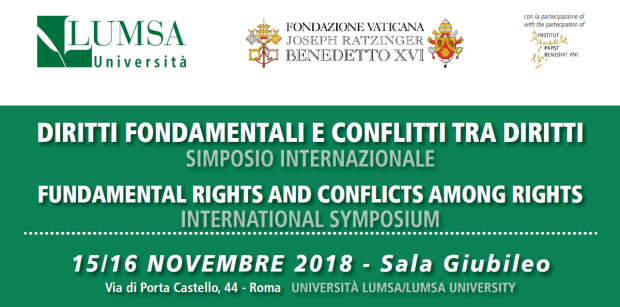
These are the key issues discussed at the International Symposium "Fundamental Rights and Conflicts Between Rights," organized by the Joseph Ratzinger/Benedict XVI Vatican Foundation in collaboration with LUMSA University. The Symposium took place on November 15-16 in Rome (Via di Porta Castello, 44 – Sala "Giubileo"), marking the 70th anniversary of the adoption of the Universal Declaration of Human Rights by the United Nations General Assembly and the 20th anniversary of the awarding of an honorary degree to then-Cardinal Joseph Ratzinger by LUMSA.
The symposium is divided into four sections: Genesis and Meaning of the Idea of Religious Freedom; Secularism and Natural Law; Birth and Transformation of the Culture of Rights and Freedoms; The Multiplication of Rights and the Danger of Destroying the Idea of Law – The Symposium saw the participation of authoritative international scholars, such as Giuseppe Dalla Torre (LUMSA), Jean Louis Ska (Pontifical Biblical Institute), Francesco D’Agostino (Rome, Tor Vergata), Robert P. George (Princeton University), Marta Cartabia (Vice President of the Italian Constitutional Court), Carlos Ignacio Massini (Mendoza, Argentina), Barbara Zehnpfennig (University of Passau), Mary Ann Glendon (Harvard University), Joseph H. Weiler (New York University), Roberto Baratta (Macerata, Italy), and a report by Cardinal Secretary of State Pietro Parolin on “The Church’s Interlocutors in the Debate and Affirmation of Human Rights”.
The various sessions were chaired by Cardinals Angelo Amato and Gianfranco Ravasi, members of the Foundation's Scientific Committee, and by the distinguished rectors of the Pontifical Lateran University, Professor Vincenzo Buonomo, and of Lumsa University, Professor Francesco Bonini.
For the occasion, Pope Francis and Pope Emeritus Benedict XVI sent messages to Father Federico Lombardi, president of the Joseph Ratzinger-Benedict XVI Vatican Foundation.
"As the 70th anniversary of the adoption of the Universal Declaration of Human Rights by the United Nations General Assembly approaches, it is appropriate not only to commemorate that historic event, but also to initiate a thorough reflection on its implementation and the development of the vision of human rights in today's world." This is the heart of the message sent by Pope Francis, read at the opening of the 8th International Symposium sponsored by the Foundation. "Pope Benedict XVI clearly perceived the urgency of these issues for our time," the Pontiff continued, "and spoke authoritatively on them as a thinker and pastor."
Pope Emeritus Benedict XVI also sent a Message, expressing "appreciation for the initiative, considering it extraordinarily useful." "In particular, it seemed important to me that explicit reference be made to the problem of the 'multiplication of rights' and the risk of 'the destruction of the idea of law,'" Benedict XVI explained. "This is a timely and fundamental issue for protecting the foundations of the coexistence of the human family, and it deserves to be once again the subject of in-depth and systematic reflection, as the Symposium program demonstrates its intention."
"Our Foundation," Father Federico Lombardi began, "aims to organize an annual international, scientific symposium on a topic of significant cultural and current relevance, related to Joseph Ratzinger's theological reflections or the teachings of Benedict XVI. In this way, we continue to enhance his cultural legacy, making it fruitful for the life of the Church and contemporary society." This year's selection focused on "a theme that was always present in Joseph Ratzinger-Benedict XVI's mind: the foundations of law, in an era characterized by the affirmation of 'human rights,' but also by their abnormal proliferation." "We will strive," Father Lombardi concluded, "to be worthy of the trust of Pope Francis and the Pope Emeritus, who encourage us."