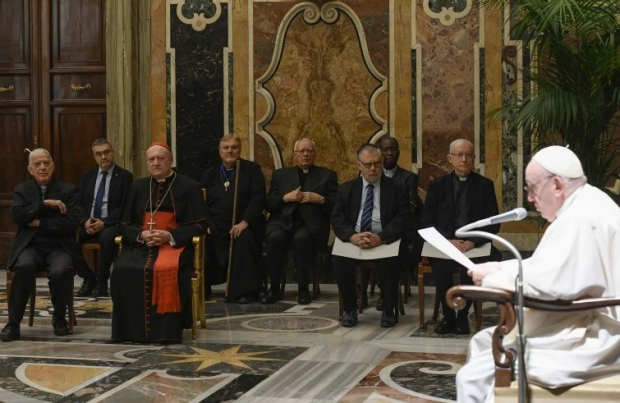
Vatican City, December 1, 2022 – “I am pleased to preside over this year's award ceremony again. As you know, I have had many moments of personal, fraternal, and affectionate encounter with the Pope Emeritus. Furthermore, we all feel his spiritual presence and his accompaniment in prayer for the entire Church: those contemplative eyes he always displays. But this occasion is important to reaffirm that the contribution of his theological work and, more generally, of his thought, continues to be fruitful and effective.” These were the first words of the address delivered this morning by Pope Francis during the audience granted to the Joseph Ratzinger-Benedict XVI Vatican Foundation for the awarding of the Ratzinger Prize, now in its twelfth year, which took place in the Clementine Hall of the Apostolic Palace in the Vatican.
This year, the recipients of this prestigious award are French biblical scholar Fr. Michel Fédou and Jewish jurist Professor Joseph Halevi Horowitz Weiler. Their academic profiles were presented by Cardinal Gianfranco Ravasi, president emeritus of the Pontifical Council for Culture and member of the Foundation's Scientific Committee.
Professor Michel Fédou, a Jesuit priest, was born in Lyon, France, in 1952. Since 1987, he has been Professor of Dogmatic Theology and Patristics at the Jesuit Centre Sèvres in Paris; he was subsequently Dean of the Theological Faculty and President of the same Center. He is a member of the boards of several theological associations and commissions for ecumenical dialogue with Lutherans and Orthodox. He is the author of numerous works, especially in the fields of patristics and Christology.
Professor Joseph H. H. Weiler was born in 1951 in Johannesburg, South Africa. He is a professor of law at numerous universities and institutes of legal studies in the United States (New York, Harvard), as well as in Great Britain and various other parts of the world. He was President of the European University Institute in Florence. He is the author of numerous works on constitutional, international, European, and human rights law. A Jew of Jewish faith, he is known for having defended Italy before the European Court of Justice in the case concerning crucifixes in schools. He received an honorary degree from the Catholic University of America.
In his greeting to the Pope, Father Federico Lombardi, president of the Ratzinger Foundation, noted that "by virtue of our mission, we continue to draw inspiration from the thought and orientation of Benedict XVI, not to remain tied to the past, but to demonstrate its fruitfulness for the Church's journey in the context of the culture and problems of our time." It is therefore "a service that seeks to positively integrate into the dynamic that characterizes his current pontificate, contributing to the ongoing reform of the Church in the wake of the Second Vatican Council, the 60th anniversary of whose opening we recently commemorated."
"This is the aim of the initiatives we promote," Father Lombardi continued, "the scholarships we award, the recognitions we bestow, collaborating with various pontifical, Catholic, and state universities—several of which are represented on this occasion—and with other cultural institutions and foundations from around the world. Special attention is paid to cultivating the dialogue between reason and faith, a hallmark of the Pope Emeritus's thought, which is essential to keeping the Church's presence alive in contemporary culture."
Focusing on the "authoritative scholars" receiving the award, Father Lombardi noted that they "enrich and expand the already large group of those awarded the Prize, which now includes 26 figures from 16 countries across five continents. They are scholars of many different disciplines, from biblical studies to historical and dogmatic theology, philosophy and the social sciences, and arts such as music and architecture. In an ecumenical spirit, they belong to various confessions: not only Catholic, but also Orthodox, Anglicans, and Lutherans. A broad spectrum, which well corresponds to the open spirit, breadth of culture, and interests of Joseph Ratzinger."
This year, the Foundation's president observed, "while the presence among us of Fr. Michel Fédou confirms our original vocation to promote theological studies, the presence of Professor Joseph Weiler demonstrates our desire to continually expand the community of award recipients. In him, we are honoring for the first time a distinguished scholar of the Jewish religion and an eminent scholar of legal disciplines. We are particularly pleased, on this occasion, to have several of his family members and friends, as well as representatives of the Roman and Italian Jewish communities, in the room to accompany him." "Beyond its significance in the name of culture, science, and art, this meeting with you this morning, Holy Father, therefore, is intended to have a profound meaning in the name of fraternity and the sincere and profound friendship between Jews and Christians," Father Lombardi concluded.
In his address, Pope Francis recalled the recent commemoration of the 60th anniversary of the opening of the Second Vatican Council. "As we know, Benedict XVI participated personally as an expert and played an important role in the genesis of several documents; and he was later called to guide the ecclesial community in its implementation, both alongside Saint John Paul II and as Pastor of the universal Church. He helped us read the conciliar documents in depth, proposing a 'hermeneutic of reform and continuity.' Very recently, he emphasized how the Council consistently fulfills its crucial role, providing us with the necessary guidance to reformulate the central question of the nature and mission of the Church in our time."
"In addition to Pope Benedict's pontifical teaching, his theological contributions are once again offered to our reflection through the publication of the Opera Omnia, the German edition of which is now nearing completion, while those in other languages continue to progress," the Pontiff continued. "These contributions offer us a solid theological foundation for the Church's journey: a 'living' Church, which he taught us to see and experience as communion, and which is on a journey—in 'synod'—guided by the Spirit of the Lord, always open to the mission of proclaiming the Gospel and serving the world in which it lives."
"In this perspective," Pope Francis observed, "the service of the Joseph Ratzinger-Benedict XVI Vatican Foundation is placed, in the conviction that its teaching and thought are not directed toward the past, but are fruitful for the future, for the implementation of the Council and for dialogue between the Church and today's world, in the most current and debated areas, such as integral ecology, human rights, and the encounter between different cultures. I take this opportunity to also encourage collaboration with the Vatican Foundations named after Blessed John Paul I and Saint John Paul II, so that the memory and vitality of the message of these three Pontiffs may be promoted through a united purpose within the ecclesial community."
Turning his gaze to the award recipients, the Pope noted that "today we are gathered to recognize two eminent figures for their remarkable work in their respective fields of study and teaching. They are different fields, but both were cultivated by Joseph Ratzinger and considered by him to be of vital importance."
Father Michel Fédou "is a master of Christian theology. In his life, dedicated to study and teaching, he particularly studied the works of the Eastern and Western Church Fathers, and the development of Christology over the centuries. But his gaze was not closed to the past. His knowledge of the tradition of faith nurtured in him a lively thought, which also addressed current issues in the fields of ecumenism and relations with other religions. In him we recognize and pay homage to a worthy heir and continuator of the great tradition of French theology, which has given the Church masters of the caliber of Father Henri De Lubac and solid and courageous cultural endeavors such as the Sources Chrétiennes, whose publication began eighty years ago. Without the contribution of this French theology, the richness, depth, and breadth of reflection that nourished the Second Vatican Council would not have been possible, and we must hope that it continues to bear fruit for its long-term implementation."
Professor Joseph Weiler "is the first Jewish figure to be awarded the Ratzinger Prize, which until now had been awarded to scholars from various Christian denominations. I am truly delighted. At a difficult time, when this had been called into question, Pope Benedict firmly and proudly stated that 'an objective of his personal theological work had been from the beginning the sharing and promotion of all the steps of reconciliation between Christians and Jews taken since the Council.'" There have been many occasions during his pontificate on which he pursued this goal; there is no need to list them here. I have continued along the same lines, taking further steps, in the spirit of dialogue and friendship with the Jews that always inspired me during my ministry in Argentina.
The harmony between the Pope Emeritus and Professor Weiler concerns particularly important issues: the relationship between faith and legal reasoning in the contemporary world; the crisis of legal positivism and the conflicts generated by an unlimited extension of subjective rights; and the proper understanding of the exercise of religious freedom in a culture that tends to relegate religion to the private sphere. Pope Benedict has always considered these issues central to the dialogue of faith with contemporary society. And Professor Weiler has not only conducted in-depth studies on them, but has also taken courageous positions, moving, when necessary, from the academic level to that of discussion—and we might call it "discernment"—to seek consensus on fundamental values and overcome conflicts for the common good. That Jewish and Christian believers can find themselves united in this is a sign of great hope."
"These Awards, therefore, in addition to representing a well-deserved recognition, offer indications of lines of commitment, study, and life of great significance, which arouse our admiration and demand to be brought to everyone's attention," the Pope concluded.
Among those present at the ceremony were Cardinal Gianfranco Ravasi and Archbishop Rino Fisichella, members of the Foundation's Scientific Committee; Cardinals Francis Arinze, Tarcisio Bertone, José Tolentino de Mendonça, Walter Kasper; Archbishops Georg Gänswein, Francisco-Javier Lozano, Agostino Marchetto, Franz-Peter Tebartz-van Elst, Emil Paul Tscherrig; Bishop Krzysztof Stefan Włodarczyk of Bydgoszcz; Italian Foreign Minister Antonio Tajani; and the President Emeritus of the Constitutional Court. Marta Cartabia, representatives of the Jewish community, members of the Diplomatic Corps accredited to the Holy See, and several scholars awarded the Ratzinger Prize in previous years.
This year, 26 people have received the Ratzinger Prize from 2011 to date, hailing from 16 different countries: Germany (7), France (4), Italy (2), Australia, Brazil, Burkina Faso, Canada, Estonia, Greece, England, Lebanon, Poland, Spain, the United States, South Africa, and Switzerland. The laureates are not only Catholics, but also members of other Christian denominations: an Anglican, a Lutheran, two Orthodox, and now also one Jewish.