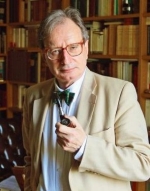
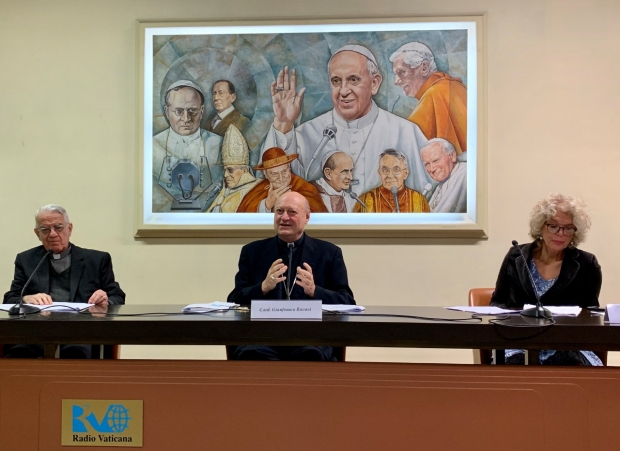
Vatican City, October 1, 2020 – French philosopher Jean-Luc Marion and Australian theologian Tracey Rowland are the scholars who will be awarded the 2020 Ratzinger Prize, now in its tenth year. Their names were announced this morning during a press conference held in Rome, at the Marconi Hall of Vatican Radio, to outline the main activities of the Joseph Ratzinger-Benedict XVI Vatican Foundation in the coming months. Along with the Foundation's president, Father Federico Lombardi, Cardinal Gianfranco Ravasi, president of the Pontifical Council for Culture and member of the Foundation's Scientific Committee, spoke, providing background information on the two academics.
"With the 2020 edition, the Ratzinger Prize will have a total of 22 recipients, hailing from 15 different countries across five continents. With Professor Rowland, we have also reached Oceania," explained Father Lombardi. "The award ceremony is scheduled for November 14th in the Apostolic Palace, as in previous editions, by Pope Francis," continued the president of the Ratzinger Foundation. "We hope the ceremony can take place despite the pandemic. If it is canceled due to force majeure, such as the inability of the two winners to attend, the 2020 Award will still be presented, but the winners will be invited to attend and receive the Diploma along with the winners of next year's 2021 Award."
Father Lombardi then recalled that last year, the 9th International Study Symposium, promoted by the Foundation in collaboration with the Hungarian Catholic University "Pázmány Péter," was held in Budapest on October 8-9. It was dedicated to the theme: "The Economic, Social, and Spiritual Situation of Central European Countries in the Light of the Social Doctrine of the Church." The location and theme—evidently timely in today's European context—were chosen to mark the 30th anniversary of the Fall of the Berlin Wall.
The Proceedings of the 2018 Symposium were published in full in English by Franciscan University Press in recent months: Fundamental Rights and Conflicts among Rights.
"While the awards and publications, as well as the annual scholarships for doctoral students, have been able to continue despite the pandemic," Father Lombardi explained, "what unfortunately had to be canceled was this year's International Symposium. It was scheduled for Beirut, ten years after the Special Synod on the Middle East convened by Benedict XVI, to reflect on the situation of the Church and Christians in the region, on dialogue with Islam, and on the commitment to peace, in light of the teachings and initiatives of recent Popes—John Paul II, Benedict XVI, and Francis." "The choice of Beirut," the president continued, "also clearly expressed solidarity with peoples and religious communities in extremely difficult situations. Unfortunately, the outbreak of the pandemic made it impossible to continue the preparations, compounded by the truly critical situation in Lebanon and the disastrous explosion in the port of Beirut. We are truly deeply saddened by this. We hope to resume this initiative in the future, not only for its cultural significance, but also for the solidarity we sought."
The hope is to hold a new international symposium in 2021, which is already underway. "The planned venue is a Catholic university in the United States. It would be the first time the Foundation has sponsored a symposium in the United States, and therefore this time the theme would revolve around the theological thought of Ratzinger-Benedict XVI. We hope that the pandemic or other difficulties will not prevent us from realizing this beautiful project," expressed Father Lombardi.
Other important initiatives demonstrating the Foundation's commitment to the academic field were also presented. The first is the "Razón abierta – Open Reason" Award, in collaboration with the Spanish University Francisco de Vitoria, now in its fourth year and inspired by a central idea in Joseph Ratzinger's thought: the ongoing dialogue between different disciplines, particularly the sciences (mathematical, natural, and human) and philosophy and theology. This year, the international jury awarded the prize in the "research" section to a major collective work on the vision of man (from psychological, philosophical, and theological perspectives): A Catholic Christian Meta-Model of the Person: Integration of Psychology and Mental Health Practice; the work "Human Embryos Human Beeings. A Scientific and Philosophical Approach"; and the work "What's the Matter? Toward a Neo-Aristotelian Ontology of Nature." In the "teaching" section, the award was given to the work (and related educational programs) "Teaching Character Virtues." A Neo-Ariostotelian Approach. The awards ceremony, accompanied by a study seminar with the participation of the Prize winners, could not be held, but the initiative appears to be very lively, with 122 submitted works, 96 universities represented, and authors from 15 different countries.
In the Central and Eastern European region, a collaborative initiative has been developed with the Nicolaus Copernicus State University of Poland in Toruń, the city of Copernicus: the "Ratio et Spes – Reason and Hope" Prize. A different specific field is identified each year, always with the aim of fostering dialogue between science, philosophy, and theology. The first edition focused on the development of Artificial Intelligence and its applications, the possibilities but also the questions it poses for humanity today. The work of a researcher from MIT in Boston and his research group (T. Poggio, A. Bańburski, Q. Liao) was recognized. The Prize is awarded on the occasion of the Copernicus University Festival, February 19th, which is also Science Day in Poland. The theme of the second edition, currently underway, concerns environmental issues. The panel of experts has already selected the papers and is now awaiting the decision of the Scientific Committee, which will be appointed together with the new Rector of the University of Toruń.
Finally, in the final months of last year, the Foundation, in collaboration with the Holy See's Observer to the United Nations Organizations in Rome (FAO, IFAD, WFP), promoted a series of seminars on ethical leadership in the face of current international challenges. The first involved participants in the Amazon Synod, while two others were held at FAO and IFAD, respectively. A fourth had to be canceled due to the outbreak of the pandemic. The presentations of the speakers at the three seminars (university professors, officials of international organizations, diplomats, etc.) are being published in a collective volume. Contacts are also underway with pontifical universities and the Francisco de Vitoria University in Madrid with a view to new future initiatives in this field.