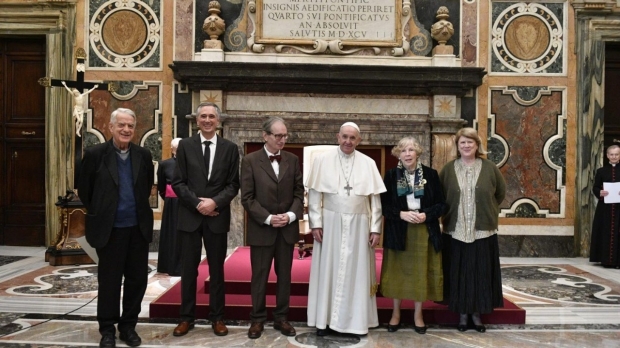
Vatican City, November 13, 2021 – An "opportunity to once again address a thought of affection, gratitude, and admiration" to Pope Emeritus Benedict XVI. This is the spirit, expressed by Pope Francis's words, that inspired those gathered in the Clementine Hall of the Apostolic Palace in the Vatican for the audience granted to the Joseph Ratzinger-Benedict XVI Vatican Foundation on the occasion of the awarding of the Ratzinger Prize, now in its eleventh year.
The prestigious recognition was awarded to Professor Hanna-Barbara Gerl-Falkovitz and Professor Ludger Schwienhorst-Schönberger. Pope Francis also presented the diplomas to the two individuals who were awarded the Ratzinger Prize in 2020, but were unable to receive the award due to the pandemic: Professor Jean-Luc Marion and Professor Tracey Rowland.
“The dynamics of the human mind and spirit are truly boundless in knowing and creating,” the Pontiff stated. “This is the effect of the ‘spark’ ignited by God in the person made in his image, capable of seeking and finding ever new meanings in creation and its history, and of continuing to express the vitality of the spirit in shaping and transfiguring matter.” “But the fruits of research and art do not mature by chance and without effort,” he continued. “Recognition therefore goes at the same time to the prolonged and patient commitment they require to reach maturity. Scripture speaks to us of God’s creation as a ‘work’. We therefore pay homage not only to the depth of thought and writings, or to the beauty of artistic works, but also to the work generously and passionately expended over so many years, in order to enrich the immense human and spiritual heritage to be shared. It is an invaluable service for the elevation of the spirit and dignity of the person, for the quality of relationships in the human community, and for the fruitfulness of the Church’s mission.”
Among the "major interlocutors" of the intellectual work of the awardees are "the great masters of philosophy and theology of our time, from Guardini to De Lubac, from Edith Stein to Lévinas, Ricoeur and Derrida, and even McIntyre," who "teach us to think in order to live an ever more profound relationship with God and others, to guide human action with virtue and, above all, with love." According to Pope Francis, "among these masters, we must include a theologian who was able to open and nourish his reflection and cultural dialogue in all these directions at once, because faith and the Church live in our time and are friends of every search for truth. I am speaking of Joseph Ratzinger."
The Pope recalled the 70th anniversary of the priestly ordination of the Pope Emeritus: “We sense that he accompanies us with prayer, keeping his gaze continually turned toward God’s horizon. It is enough to look at him to realize this. Today we thank him in particular because he was also an example of passionate dedication to study, research, and written and oral communication; and because he always fully and harmoniously united his cultural pursuits with his faith and his service to the Church.” Furthermore, Benedict XVI “continued to study and write until the end of his pontificate. About ten years ago, while fulfilling his governing responsibilities, he was busy completing his trilogy on Jesus and thus leaving us a unique personal testimony of his constant search for the face of the Lord. It is the most important search of all, which he then continued to pursue in prayer. We feel inspired and encouraged by this, and we assure him of our remembrance before the Lord and of our prayers.”
The Pope finally reflected on the motto chosen by Joseph Ratzinger when he became Archbishop of Munich: the words from the Third Letter of John, "Cooperatores Veritatis." According to the Pontiff, these words "express the common thread running through the various stages of his life, from study to academic teaching, to episcopal ministry, to service for the Doctrine of the Faith—to which he was called by Saint John Paul II 40 years ago—up to his Pontificate, characterized by a luminous magisterium and an unfailing love for the Truth." "Cooperatores Veritatis," Francis concluded, "is therefore also the motto that stands out on the diplomas awarded to the award recipients, so that it may continue to inspire their commitment. These are words that each of us can and must draw inspiration from in our work and in our lives, and which I leave to all of you, dear friends, as a good wish, together with my blessing."
In his greeting to the Pope, Father Federico Lombardi, president of the Ratzinger Foundation, noted that the Prize is "the central event in the life of this Foundation, yours and ours, which was established by your predecessor to promote the study of theology, the sacred and human sciences, and the Christian-inspired arts." "The list of award recipients is now extensive. It includes 24 scholars from 15 countries and every continent," Father Lombardi emphasized. "The disciplines they pursue span diverse fields of theology, philosophy, and art. A fascinating horizon that is expanding year by year. A concrete demonstration of the Church's appreciation for the commitment to study and the pursuit of truth and beauty."
The Prize "is not an acknowledgment for a particular work," the president clarified, "but for the long and in-depth work of the individuals we present to you, demonstrated by their publications and their body of work. Our gratitude goes to them for sharing the fruits of their labors with a broad audience."
Regarding the Foundation's other activities, Father Lombardi noted that "the scientific conferences, which are also a hallmark of our work, have been paused over the past two years due to the pandemic, but we hope to resume them soon. Scholarship awards, however, have continued at their usual pace; we have also been able to produce some publications; and we have continued our collaboration with various universities, including the Pontifical University of Rome, the Francisco de Vitoria University in Madrid, and the Nicolaus Copernicus University in Toruń."
Professor Marion and Professor Rowland were profiled by Cardinal Gianfranco Ravasi, President of the Pontifical Council for Culture, while those of Professor Gerl-Falkovitz and Professor Schwienhorst-Schönberger were profiled by Monsignor Rudolf Voderholzer, Bishop of Regensburg.
Among those present at the ceremony were members of the Foundation's Scientific Committee, Cardinals Kurt Koch, Luis Francisco Ladaria, and Gianfranco Ravasi, and Monsignor Rudolf Voderholzer; the Dean of the College of Cardinals, Giovanni Battista Re; Cardinals Lorenzo Baldisseri, Tarcisio Bertone, José Tolentino de Mendonça, Walter Brandmüller, Fernando Filoni, Marc Ouellet, Franc Rodé, Beniamino Stella, and Silvano Maria Tomasi; archbishops and bishops, including Andrés Gabriel Ferrada Moreira, Georg Gänswein, Gianfranco Girotti, Antonio Mennini, Guido Pozzo, Marcelo Sánchez Sorondo, Ignazio Sanna, Franz-Peter Tebartz-van Elst, and Lazzaro You Heung-sik; members of the Diplomatic Corps accredited to the Holy See; and several scholars who have received the Ratzinger Prize in previous years. With this edition, the number of personalities who have received it since 2011 to date has risen to 24, coming from 15 different countries.
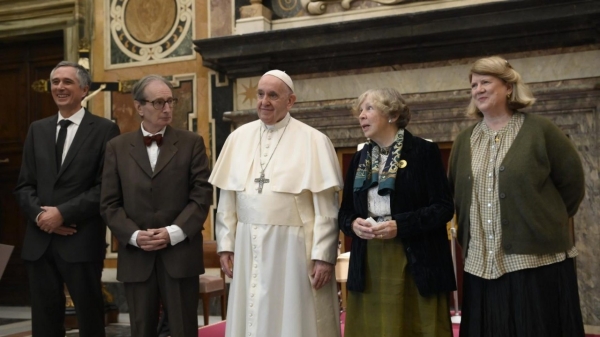 photo Vatican Media