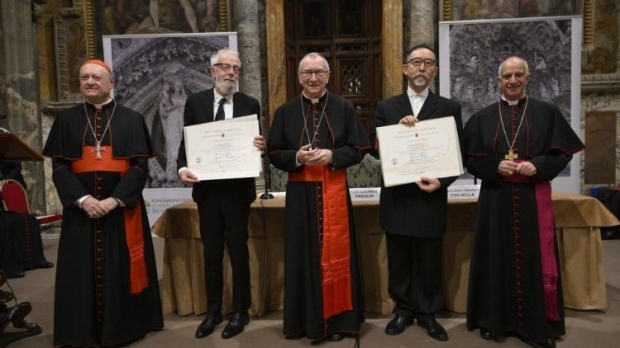
Vatican City, November 22, 2024 – “Today, in light of the approaching opening of the Jubilee, which Pope Francis has placed under the banner of hope, I would like to recall that Benedict's voice is one of the loud voices of hope that must accompany us. (…) In the dark times we are experiencing, Benedict XVI is a teacher who, while aware of the presence of evil and the tragedies of historical events, helps us to raise our gaze and rediscover solid foundations to continue looking forward, toward unity, truth, beauty, and love.” This was the central passage of the address delivered by Cardinal Secretary of State Pietro Parolin this afternoon in the Sala Regia of the Apostolic Palace in the Vatican, on the occasion of the award ceremony of the Ratzinger Prize to Professor Cyril O’Regan, Professor of Theology at Notre Dame University (USA), and Maestro Etsurō Sotoo, sculptor (Japan/Spain).
Introducing the ceremony, Father Federico Lombardi, president of the Joseph Ratzinger-Benedict XVI Vatican Foundation, emphasized that Professor O'Regan and Maestro Sotoo "were born in Ireland and Japan, respectively: with them, the number of award recipients extends to 18 different countries, spread across five continents." Father Lombardi added that "the welcome presence today of a good number of past award recipients (Professors Beré, Blanco Sarto, Chrostowski, Rowland, Schaller, and Schlosser) demonstrates that they, in a certain sense, constitute a 'community.' A community that is global from a geographical perspective, and ecumenical from a religious perspective, which recognizes the great ideals of Ratzinger-Benedict: cultivating an 'open reason,' an intelligence in research and dialogue, which spans disciplines and the arts, making us 'cooperators of truth,' so that it can nourish minds, hearts, and life."
Monsignor Rino Fisichella and Cardinal Gianfranco Ravasi, members of the Foundation's Scientific Committee, then presented the profiles of the two winners of the 2024 edition, Professor Cyril O'Regan and Maestro Etsurō Sotoo, who then had the opportunity to address those present.
Professor Cyril O'Regan (Ireland, 1952).
Professor of Systematic Theology in the Department of Theology at the University of Notre Dame (Indiana, USA).
Studied philosophy in Ireland. He then earned a Doctorate in Philosophy (1985) and a Doctorate in Theology (1989) from Yale University (USA). Professor since 1990 at Yale University, Department of Religious Studies, and since 1999 at Notre Dame University, Department of Theology.
Main fields of study: Systematic Theology and History of Christianity.
Author of numerous articles and various works, including: The Heterodox Hegel (1994); Gnostic Return in Modernity (2001); Theology and the Spaces of Apocalyptic (2009); Anatomy of Misremembering: Balthasar's Response to Philosophical Modernity (2 volumes); Newman and Ratzinger (forthcoming).
He is an intensely active teacher, highly appreciated by his students for his attentiveness to them. He has dedicated several important articles to the figure and teachings of Joseph Ratzinger-Benedict XVI.
Etsuro Sotoo (Fukuoka, Japan, 1953).
A graduate of Fine Arts from Kyoto University (Japan), he taught initially in Kyoto and Osaka.
Visiting Barcelona in 1978, he was deeply impressed by the construction of the Sagrada Familia Basilica and asked to work there as a sculptor, starting with the Nativity Facade, following the instructions left by Antoni Gaudí. He converted to Christianity and was baptized. He is a fervent devotee of Gaudí, also committed to his cause for canonization.
His major works are in various parts of the Sagrada Familia church, as well as elsewhere in Spain, Japan, and even Italy, having created the pulpit for the Santa Maria del Fiore cathedral in Florence in 2015.
He is the first East Asian and the first sculptor to be awarded the Ratzinger Prize.
As is well known, Pope Benedict XVI consecrated the Sagrada Familia basilica during a trip to Barcelona in 2010, expressing his high appreciation for the figure and art of Antoni Gaudí.
After reviewing the various activities promoted by the Foundation, including in collaboration with various universities around the world, Father Lombardi recalled that "with the passage of time, it doesn't seem as if our mission is ending; on the contrary, it is being strengthened. From different countries and continents, we frequently receive news of new cultural and academic initiatives, institutes, professorships, research projects, and so on, all of which draw on Joseph Ratzinger-Benedict XVI, his thought and work. These initiatives arise and develop through their own vitality, yet they desire and strive to connect with one another to enrich and support one another, in the belief in the timeliness and fruitfulness of this great Pope's inspiration, looking not so much to the past as to the future of the Church's mission and the questions facing humanity."
In his unread speech, delivered to those present, Cardinal Parolin emphasized that "we can recognize in the now long list of award recipients a non-superficial unity and coherence. In a certain sense, we could speak of a 'consonance' with the thought, sensibility, and human and Christian witness of Joseph Ratzinger-Benedict XVI. We can and must also see this 'consonance' in the awarding of this prize." "Ratzinger-Benedict's reflection and teaching," Cardinal Parolin continues, "have encompassed a very broad range of theological and cultural problems and themes, and we might even say social and political ones, but he has never lost the ability to see them and highlight their relationship with God through the search for truth. This has exemplified his fruitful idea that human reason must always remain 'open,' that every discipline must not confine itself to sterile positivism, that questions about the meaning of life, history, and the world remain ever timely, necessary, and incumbent upon people of every time, culture, and situation. And even though he is convinced that the ultimate answer to these questions lies in the truth revealed in Christ, the search for this truth and its deeper understanding remains an open and surprising task, without which the dignity of the human person is debased and the direction of our journey is lost."
Focusing on the profiles of the two award winners, the Cardinal Secretary of State notes that "as Professor O'Regan emphasized in several of his insightful profiles of Joseph Ratzinger-Benedict XVI, his voice was always characterized by profound humility, by the clear desire to be the voice not of himself, but of the tradition of the Church, at the service of the voice of the Lord Jesus; his vision was always centered on God, who reveals himself by giving us every good thing in Jesus Christ."
Regarding Maestro Sotoo, the Cardinal emphasizes that "all the voices of creation and history, especially the voices of salvation history, are those that art also helps us hear and see. True art makes matter transparent to the spirit. We experience this in a fascinating way in the immense undertaking of the construction of the Sagrada Familia, in all its details, including the works of Maestro Sotoo. We have heard of their meaning and inspiration from his own lips. The stone, apparently hard and inert, thanks to the creative work of the architect and the sculptor, the toil of the craftsman and the worker, becomes the living voice of God's creation and a manifestation of His beauty and His love, a space where the assembly of the Church, itself made up of living stones built on the rock that is Christ, encounters God in prayer and in the celebration of the sacraments."
Cardinal Parolin then recalls the motto chosen by the bishop and Pope Benedict: "Cooperatores Veritatis." This remains the motto of those who dedicate their lives to making truth shine in all its forms, through intelligence, research, and teaching, through the brilliance and dedication of artistic expression, through the testimony of their human and ecclesial service. This is therefore the motto that also characterizes the lives and work of the award recipients, and today we re-entrust it to them so that they may continue to be effective witnesses to it.
Finally, recalling "his unforgettable encyclical Spe Salvi," which "is entirely dedicated to hope, to human hopes, and to Christian hope," the Cardinal observes that Benedict XVI "with courage and passion, speaks to us of the mystery of God's judgment on the world and on history in the light of justice and mercy, encouraging us to bear in faith and hope the terrible burden of the raging hatred and evil that oppresses our age and crushes countless human lives around us every day. The vision of Christ Pantocrator, which he contemplated in his reflection and prayer until the last days of his life and to which he entrusted himself with trust, is a vision of great hope, for each and every one of us. When the glorious Christ opens his mouth, he says, 'Do not be afraid! I am the First and the Last, and the Living One. I was dead, but behold, I am alive forevermore, and I have the keys of death and Hades' (Rev 1:17-18).
"Pope Benedict," the Cardinal concluded, "continues to accompany us so that we too may share, in harmony with him, in his vision of faith, charity, and hope."
Today began with a Mass in memory of Benedict XVI, celebrated in the Vatican Grottoes, near his tomb, presided over by Archbishop Georg Gänswein, Apostolic Nuncio to Lithuania, Estonia, and Latvia. A moment lived "in profound spiritual union with Benedict XVI," Father Lombardi noted, "so that he may continue to accompany and inspire us on our journey of faith and Christian commitment."
Afterwards, the two award recipients were received in audience by Pope Francis, "to receive—as Father Lombardi, who accompanied them, explained—his blessing and to reaffirm to him the closeness and desire of our Foundation and all of us to be fully integrated into the journey of the Church he leads and to contribute according to our vocation and ability."
In addition to the members of the Foundation's Scientific Committee, Cardinals Kurt Koch, Luis Francisco Ladaria, and Gianfranco Ravasi, and Archbishop Rino Fisichella, the ceremony was attended by, among others, the Dean of the College of Cardinals Giovanni Battista Re, Cardinals Baldisseri, Fernandez Artime, Marchetto, Müller, Roche, Vegliò, and Bishop Staglianò.
The ceremony was enlivened by musical interludes provided by the Falconieri Ensemble (Ancient Music).
With the 2024 edition, a total of 30 individuals have been awarded the Ratzinger Prize.
These are primarily eminent figures in dogmatic or fundamental theology, Sacred Scripture, Patrology, Philosophy, Law, Sociology, or in artistic activity, music, architecture, and now also sculpture.
Confirming the Prize's global cultural horizon, the recipients come from 18 different countries across five continents: Germany (7), France (4), Spain (3), Italy (2), Australia, Brazil, Burkina Faso, Canada, Estonia, Japan, Great Britain, Greece, Ireland, Lebanon, Poland, the United States, South Africa, and Switzerland.
The laureates are not only Catholics, but also members of other Christian denominations—one Anglican, one Lutheran, two Orthodox—and one is Jewish.