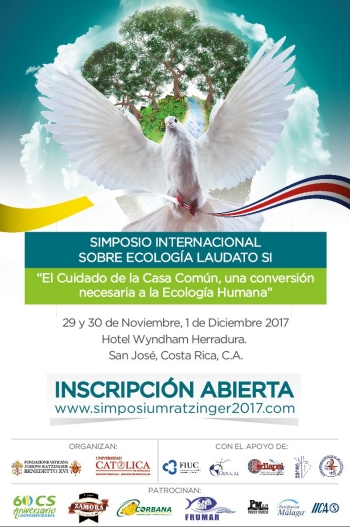
The International Symposium "Laudato si' – Care for the 'Common Home,' a Necessary Conversion for Human Ecology" took place in San José, Costa Rica, from November 29 to December 1, 2017. The Symposium focused on the theme of sustainable development for our planet and was promoted by the Joseph Ratzinger-Benedict XVI Vatican Foundation together with the Catholic University of Costa Rica. The Symposium featured internationally renowned speakers and was held at the Wyndham San José Herradura Hotel in San José. Over 700 participants from 23 different countries attended.
The event began with a Mass presided over by Cardinal Marc Ouellet, Prefect of the Congregation for Bishops, and was inaugurated by the President of the Republic of Costa Rica, Luis Guillermo Solís, who declared the event to be of public interest. During the Symposium, a tool for measuring the development index of countries around the world was presented, based on the environmental indicators proposed in Pope Francis's encyclical Laudato si'. The Laudato si' Observatory was also inaugurated at the Catholic University of Costa Rica. Its goal will be to measure the planet's environmental and social situation, collecting data to feed a development index, and sharing the results of each measurement and the resulting studies.
The initiative is promoted by the Catholic University and the Joseph Ratzinger-Benedict XVI Vatican Foundation, one of whose objectives is to organize conferences of high cultural and scientific value. This is its seventh annual Symposium. Previous ones were held in Bydgoszcz, Poland (2011); Rio de Janeiro, Brazil (2012); Rome (2013); Medellín, Colombia (2014); Madrid, Spain (2015); Rome (2016). The aim of these meetings is to promote academic and pastoral dialogue on theological issues and study initiatives at the various universities hosting the event. This year, the Catholic University of Costa Rica, the institute of higher education of the Costa Rican Episcopal Conference, was chosen as the venue. This decision demonstrates recognition of Costa Rica's important role in ecological and environmental issues.
Some of the topics addressed during the Symposium were:
- Why did Pope Francis write the Encyclical?
- The ecology of man: the voice of Benedict XVI
- Peace, justice, and development: towards a sociology of the integral ecology of the human being
- Laudato Si' applied to our territory: challenges and prospects
- The current social situation of our "common home." The state of social progress in 2017
- Presentation of the integrated humanistic model for global measurement
- The care of creation and the integral ecology of the human being at the center of Catholic education
- Care for the "common home": the importance of the Amazon.
The initiative was attended by academics, scientists, entrepreneurs, priests, seminarians, students from various fields, men and women religious, educators, political figures, and individuals interested in caring for our "common home." As a symposium on "practical theology" and with a global theme, the event transcended the confines of the Catholic Church and became an activity of general common interest.
Organizers
The Joseph Ratzinger-Benedict XVI Vatican Foundation
Established on March 1, 2010, its objectives are the publication, dissemination, and study of the writings of Joseph Ratzinger-Benedict XVI, as well as the organization of conferences of high cultural and scientific value and the awarding of prizes to scholars of theology and related disciplines who distinguish themselves through particular merit, both in their publications and in their scientific research.
www.fondazioneratzinger.va
The Catholic University of Costa Rica
The Catholic University of Costa Rica "Anselmo Llorente y Lafuente" (UCAT) was founded in May 1993, at the initiative of the Bishops of the Episcopal Conference of Costa Rica. It belongs to the Costa Rican Catholic Church, which governs it through the Catholic University of Costa Rica Foundation. The current rector is Dr. Fernando Felipe Sánchez Campos, appointed in September 2015.
The Catholic University of Costa Rica was approved and authorized by the National Council of Higher Education (CONESUP) in May 1993 and currently has four campuses. The main one is in San José; the others are in San Carlos, which has a comprehensive Catholic education system (preschool, St. Francis of Assisi School and College, through higher education), Ciudad Nelly (half an hour from the Panamanian border), and Nicoya.
The university currently offers 39 CONESUP-approved programs at baccalaureate and undergraduate levels, and 13 postgraduate programs, including master's and doctoral degrees.
www.ucatolica.ac.cr
The Symposium was also supported by:
Organization of Catholic Universities of Latin America and the Caribbean (ODUCAL):
It is affiliated as a Regional Association with the International Federation of Catholic Universities (FIUC). It contributes to the advancement of knowledge and the development of a more just and humane world, in the light of the Christian faith and thanks to the spirit of the Gospel (Article 2 of the FIUC Statutes). It brings together more than 103 countries.
International Federation of Catholic Universities (FIUC):
It was established by decree of the Holy See in 1948 and recognized by Pope Pius XII in 1949. It actively collaborates with the Congregation for Catholic Education and maintains privileged relations with the Vatican Dicastery for the Laity since its creation in 1976.
FIUC currently comprises more than 210 Catholic universities and schools.
Episcopal Council of Latin America (CELAM):
CELAM is a body of the Church of Latin America that aims to promote channels of communion, reflection, collaboration, and service among local Churches, as a sign and instrument of collegial affection, in communion with the universal Church. It was created in 1955, with its headquarters in Bogotá, Colombia.
Visit the Symposium website: http://simposiumratzinger2017.com/informacion-general/.