Vatican City, December 1, 2023 – "A living legacy, to continue to bear fruit on the Church's journey in our time, looking not backward, but forward." This was the heart of the speech by Cardinal Secretary of State Pietro Parolin, delivered at the Ratzinger Prize award ceremony, almost a year after the death of Benedict XVI, the first time the Prize has been awarded since his passing.
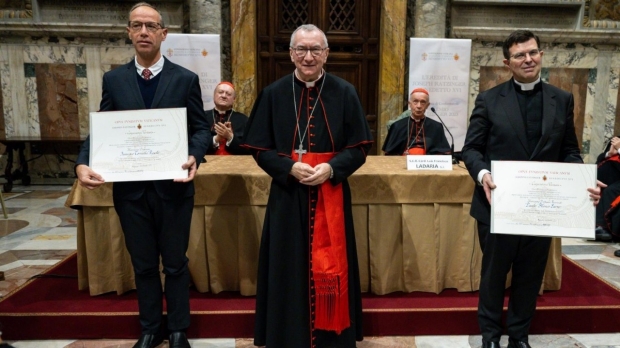
The award ceremony took place yesterday afternoon, November 30, in the Sala Regia of the Apostolic Palace in the Vatican. That morning, in the Vatican Grottoes, Father Federico Lombardi, president of the Ratzinger Foundation, presided over a Mass in profound spiritual union with Benedict XVI, asking the Lord to reward him for his service, but also that his spiritual and cultural legacy may continue to bear precious fruit for the Church and for the good of humanity.
Introducing the ceremony, Father Lombardi, after reviewing the various activities the Foundation promotes, including in collaboration with various universities around the world, recalled that "Joseph Ratzinger never intended to construct his own system of thought or establish his own school. Rather, he taught us to seek and find truth with the power of reason and the light of faith, always maintaining an 'open' mind in dialogue between people, disciplines, and the great religious traditions. We believe our Foundation, named after him, should also act in this spirit, not only to study his life and thought, looking to the past, but also to make a contribution—even a small one—to continue his journey, looking to the present and the future."
Cardinals Luis Francisco Ladaria and Gianfranco Ravasi, members of the Foundation's Scientific Committee, then presented the profiles of the two 2023 awardees, Rev. Professor Pablo Blanco Sarto and Professor Francesc Torralba, who then addressed those present.
Pablo Blanco Sarto was born on July 12, 1964, in Zaragoza, Spain. He studied Hispanic Philology at the University of Navarra. In Rome, he completed his studies in Theology at the Pontifical University of the Holy Cross, then began his degree and doctorate in Philosophy, focusing on the thought of Luigi Pareyson (1918-1991). He was ordained a priest on September 21, 1997. In 2005, he completed a Doctorate in Dogmatic Theology at the University of Navarra, with a thesis on Joseph Ratzinger's fundamental theology and the religions of theology. He is currently a full professor at the University of Navarra in the areas of ecumenism, sacramental theology, and ministry. He collaborates with the Institut Papst Benedikt XVI in Regensburg (Germany), with numerous Spanish and Latin American academic institutions, and with various publishing houses and theological and pastoral journals. He is a member of the editorial board of the Complete Works of Joseph Ratzinger in Spanish at the BAC. He is the author of numerous studies and volumes on the life, thought, and work of Joseph Ratzinger-Benedict XVI.
Francesc Torralba Roselló is a philosopher and theologian. Born in Barcelona on May 15, 1967, he is married with five children. He holds doctorates in Philosophy from the University of Barcelona (1992), in Theology from the Faculty of Theology of Catalonia (1997), in Pedagogy from the Ramon Llull University (2018), and in History, Archaeology, and Christian Arts from the Ateneu Universitari Sant Pacià, Antoni Gaudí Faculty (2022). He is currently an accredited professor at the Ramon Llull University and teaches courses and seminars at other universities in Spain and America. He combines his teaching with his commitment to writing and disseminating his thought, which focuses on philosophical anthropology and ethics. A prolific author, he has published more than 1,800 articles and over 100 books.
In his address, Cardinal Parolin emphasized that "unlike the pontificates of his predecessor and successor, that of Benedict XVI does not present itself as a time of exceptional dynamism on the international and global political scene, but rather as a magisterium characterized by awareness and a profound understanding of the cultural and spiritual situation of the world at the beginning of this millennium." Furthermore, Benedict XVI, "bringing to his service as Supreme Pastor the rich reflections of his entire previous life, helped us understand the profound reasons for problems and find solid foundations on which to base the search for solutions." He also emphasized "the need for the harmonious contribution of faith and reason in seeking and finding the path to truth, the meaning of human existence and its dignity, in distinguishing good from evil for the salvation of the individual and the human community, in establishing law and justice, and peaceful coexistence," the Secretary of State recalled.
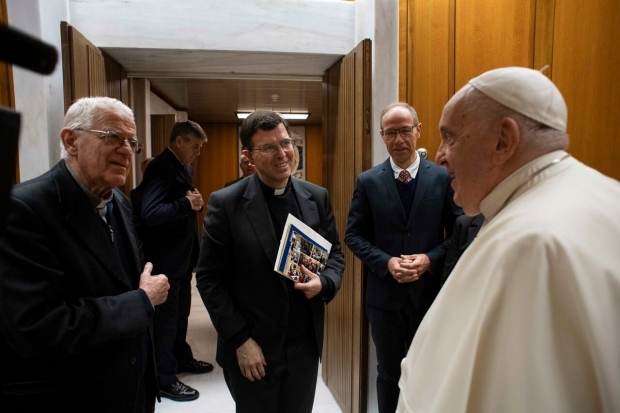
Yesterday morning, the two award recipients, accompanied by Father Lombardi, were also received in audience by Pope Francis. During the meeting, Father Lombardi was able to reiterate how the Award and the Foundation's entire commitment are intended to be coherently integrated into the Church's journey, which he leads today. He consistently emphasized the living continuity of the service of the supreme pastors of the Church of our time, particularly in the study and implementation of the Second Vatican Council in the context of the contemporary world.
In addition to the members of the Foundation's Scientific Committee, Cardinals Luis Francisco Ladaria and Gianfranco Ravasi, and Archbishop Rino Fisichella, the ceremony was attended by, among others, the Dean of the College of Cardinals Giovanni Battista Re, Cardinals Baldisseri, de Mendonça, Kasper, Marchetto, Müller, Ouellet, Tscherrig, You Heung-sik, Archbishop Pozzo, and Bishops De Nicolò and Staglianò.
With the 2023 edition, the total number of Award recipients has risen to 28.
The honorees thus far have been primarily scholars of dogmatic or fundamental theology, Sacred Scripture, Patrology, and philosophy, as well as eminent artists in music and architecture.
Confirming a global cultural horizon, the recipients of the Prize come from 16 different countries: Germany (7), France (4), Spain (3), Italy (2), Australia, Brazil, Burkina Faso, Canada, Estonia, Greece, England, Lebanon, Poland, the United States, South Africa, and Switzerland.
The laureates are not only Catholics, but also members of other Christian denominations: one Anglican, one Lutheran, two Orthodox, and one Jewish.
The previous day, November 29, the conference "Benedict XVI's Legacy: Unfinished Debates on Faith, Culture, and Politics" was held in the Aula Magna of the Pontifical Gregorian University. This was the first stage of a project promoted by the Gregorian, the de Nicola Center for Ethics & Culture (University of Notre Dame, Indiana), the Ratzinger Foundation, and the Benedict XVI Institute in Regensburg, which will continue in the United States (University of Notre Dame) in the spring of 2024. The aim is to foster an intergenerational dialogue on the major issues of contemporary society related to faith, culture, and politics. Benedict XVI's thought can be understood as a legacy to be passed on to new generations of thinkers. This begins with discussions among internationally renowned scholars on some of his major speeches, such as those given in New York, London, and Berlin, which touch on crucial political aspects: the foundation of human rights, the liberal democratic tradition, the foundation of justice, and the debate on natural law. And again, the speeches in Regensburg, Rome, and Paris, which concern the academic-cultural sphere: the relationship between faith and reason, the contribution of Christianity to culture, the autonomy of science and its relationship with faith.