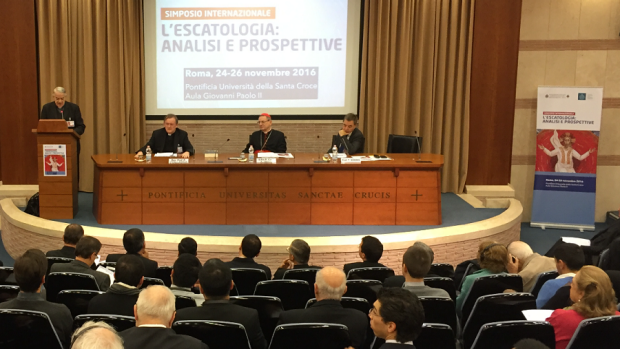
The 6th International Symposium of High Scientific Value, promoted by the Joseph Ratzinger-Benedict XVI Vatican Foundation, took place at the Pontifical University of the Holy Cross in Rome on November 24 and 25, 2016. The theme was "Eschatology: Analysis and Perspectives," one of the favored topics in Joseph Ratzinger's theological research.
"It is a very timely theme," noted the Foundation's president, Father Federico Lombardi, in his introductory remarks, "on which the Pope Emeritus continues to reflect and pray and which today, at this stage of his life, he lives very intensely." Professor Ratzinger's last volume before his appointment as archbishop, "Eschatology: Death and Eternal Life," published in 1977, was dedicated to eschatology, as noted by the rector of the Santa Croce Foundation, Luis Navarro. He himself called it his "most accomplished work."
Contemporary man, "absorbed by the manifold attractions of earthly things," seems "no longer able to perceive God at work in his present history and his future," noted Cardinal Angelo Amato, prefect of the Congregation for the Causes of Saints and president of the Foundation's Scientific Committee, in his report on "Eschatology and Sanctity." In reality, he "always discovers himself to be a fragile and helpless victim in the face of illness, natural disasters, and terrorist acts." For much of contemporary culture, however, "death seems to be an antiquated, disturbing taboo. It must therefore be silenced." There is, however, a great host of saints, blesseds, and mystics, who "live on earth but with their gaze turned to heaven, not as a utopia but as reality. Heaven is their homeland, their dwelling, their home."
According to Paul O'Callaghan, who focused on "Eschatology in the Thought of Joseph Ratzinger," for the great German theologian, eschatology is "salvation; more concretely, it is the temporal application of Christ's saving work, until the Father closes history with the Judgment."
"Eschatology," Thomas Söding stated, before exploring the theme in the Gospel of Matthew, "is concerned with what is at the end, since it is essential from the beginning."
Monsignor Romano Penna was entrusted with exploring eschatology in Pauline thought: "According to Paul, the Christian is invited to combine the future and the present, expectation and fullness, both eschatological. The two moments are in fact united by Jesus Christ, who has played and continues to play the role of a bridge uniting and communicating between the two shores. According to the Letter to the Hebrews, "Christ is the same yesterday, today, and forever." But even for the Apostle Paul, it would make no sense to say that "we will always be with the Lord," if we were not already a kaine ktísis in him today."
The Chief Rabbi of Rome, Riccardo Di Segni, finally introduced the large audience to "Eschatology in Classical Rabbinic Thought."
The first day of the Symposium continued with the workshop “Eschatological Perspectives in Judaism,” featuring presentations by Chief Rabbi Giuseppe Momigliano of Genoa (“The Hebrew Bible and Eschatology, a Jewish Reading”) and Professor Moshe Idel of the Hebrew University of Jerusalem (“Jewish Messiahs and the Pope; Abraham Abulafia and Solomon Molkho”).
The second day opened with a presentation by Cardinal Kurt Koch, president of the Pontifical Council for Promoting Christian Unity, on "Eschatology in the Faith of the Church." This was followed by presentations by Bernardo Estrada ("Luke-Acts: Eschatology or the History of Salvation?") and Maurizio Marcheselli ("Eschatology in John").
In the afternoon, a workshop was held on "Questions of Eschatology Today," with presentations by Giovanni Ancona ("Eschatological Thinking Today"), Riccardo Battocchio ("The Treatise on Eschatology Between Uncertainties of Meaning and Structural Placement"), Santiago Del Cura Elena ("Final Eschatology: The Last Judgment, the Year of Justice, and the Sense of History"), and Robert Wozniak ("Persons in Relations: Rediscovering a Classical Paradigm of Christian Eschatology").
The conference concluded on the morning of November 26 at the Augustinianum Patristic Institute, with a presentation by Cardinal Gianfranco Ravasi, president of the Pontifical Council for Culture, on the topic "What Eschatology for Jesus of Nazareth?"
The 6th International Symposium on Eschatology, promoted by the Ratzinger Foundation, was a high-level scholarly event following events in Bydgoszcz, Rio de Janeiro, Rome, Medellín, and Madrid. The date for the 7th Symposium has already been set: November 29-30 and December 1, 2017, at the Catholic University of San José in Costa Rica, on the topic "Laudato si' – The Care of the Common Home: A Necessary Conversion."