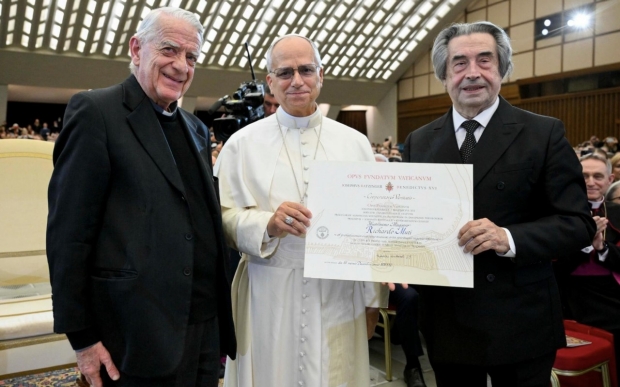
Vatican City, December 13, 2025 – "It seems particularly fitting to award the Ratzinger Prize to someone who has preserved what Benedict XVI has always considered the heart of art: the ability to resonate, through beauty, a spark of God's presence." With these words, Pope Leo XIV greeted the presentation of the Ratzinger Prize to Maestro Riccardo Muti, which took place yesterday evening, December 12, in the Paul VI Hall in Vatican City, following the Christmas Concert in honor of and in the presence of the Holy Father.
Maestro Muti conducted the performance of the Mass for the Coronation of Charles X, composed by Luigi Cherubini in 1825, by the Luigi Cherubini Youth Orchestra, which he founded, accompanied by the "Guido Chigi Saracini" Choir of the Siena Cathedral.
"I extend my greeting to Maestro Riccardo Muti, who is being awarded the Ratzinger Prize today, a sign of appreciation for a life entirely devoted to music, a place of discipline and revelation," Pope Leo stated, noting that "Pope Benedict XVI loved to recall that 'true beauty wounds, opens the heart, expands it,' and in music he sought the voice of God in the universe." "In this journey of seeking beauty, dear Maestro," Pope Leo continued, "you had the opportunity to meet Cardinal Ratzinger several times, beginning when he attended concerts in Salzburg, Munich, and then Rome. In subsequent years, Pope Benedict attended your performances in the Paul VI Hall, where he awarded you the Grand Cross of St. Gregory the Great. The Prize you receive today is the continuation of that relationship, of a dialogue open to mystery and oriented toward the common good, toward harmony."
The Pontiff then recalled his predecessor, Pope Francis, "who loved music and listened to it with spiritual delight. Music, he said, “gives those who cultivate it a wise and calm outlook, with which divisions and antagonisms can more easily be overcome, to be – just like the instruments of an orchestra or the voices of a choir – in harmony, to watch for discord and correct dissonances, which are also useful for the dynamics of compositions, as long as they are integrated into a wise harmonic fabric.”
The Concert, promoted by the Gravissimum Educationis Foundation of the Dicastery for Culture and Education, with the support of the Galileo Foundation, "is an opportunity to raise awareness and demonstrate commitment to education: millions of boys and girls around the world are excluded from any form of schooling," the Pope concluded.
"This Prize," explained Father Federico Lombardi, president of the Ratzinger Foundation, "was established in recognition of outstanding cultural achievements in the fields of thought and art, the fruit of tireless commitment to and promotion of fundamental spiritual values." "There is no doubt that the life and work of Maestro Riccardo Muti are eminent and universally recognized testimony to this," Father Lombardi continued. "The depth of his interpretation of sacred and religiously inspired music continues to nourish and elevate the relationship between the art of music, faith, and the Church. The mutual esteem and harmony between Maestro Muti and Pope Benedict XVI, also expressed in their personal meetings, makes it entirely appropriate, and in a certain sense dutiful, to award the Maestro the recognition that bears the name of the Pope, theologian and musician.
With the 2025 edition, a total of 31 individuals have been awarded the Ratzinger Prize.
These are primarily eminent figures in the fields of dogmatic or fundamental theology, Sacred Scripture, Patrology, Philosophy, Law, Sociology, or in artistic activity, music, architecture, and sculpture.
Confirming the Prize's global cultural horizon, the recipients come from 18 different countries across five continents: Germany (7), France (4), Spain (3), Italy (3), Australia, Brazil, Burkina Faso, Canada, Estonia, Japan, Great Britain, Greece, Ireland, Lebanon, Poland, the United States, South Africa, and Switzerland.
The awardees are not only Catholic, but also members of other Christian denominations – one Anglican, one Lutheran, two Orthodox – and one is Jewish.