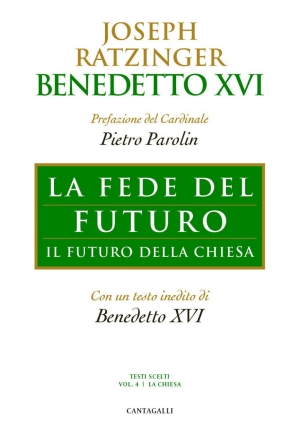
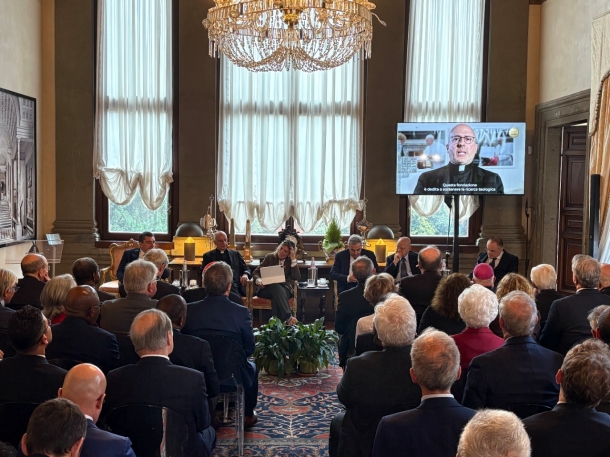
April 16, 2026 – On the 99th anniversary of the birth of Pope Benedict XVI, the Italian Embassy to the Holy See hosted the presentation of the book "The Faith of the Future. The Future of the Church," volume 4 of the "Selected Texts" by Joseph Ratzinger-Benedict XVI, published by Cantagalli, at Palazzo Borromeo in Rome.
The Italian Ambassador to the Holy See, Francesco Di Nitto, noted in his greeting that "Pope Benedict XVI addresses the process of transformation of the Church, the relationship between faith and modernity, the connection between Church, society, and the world, as well as the future of Christianity, from a perspective of hope rooted in faith." "Aware of the complexity of the times in which we live," the Ambassador concluded, "the message of faith and hope that emerges from the work remains timely and urges us to look to the future with renewed confidence, fostering that spirit of unity essential to continuing to think in terms of humanity as a whole and the common good, especially in the troubled times we are living in."
Senator Riccardo Pedrizzi, president of the Technical Scientific Committee of the Christian Union of Entrepreneurs and Managers, introduced the proceedings by mentioning the centenary of the Cantagalli publishing house, founded in 1925, with the aim of "bringing the doctrine of the Church and the texts of the Popes and Church Fathers to the knowledge of all, even the humblest people."
Turning his attention to the Italian situation, Senator Maurizio Gasparri, president of the Senate Foreign Affairs and Defense Committee, urged reflection on "what our cities would be like without the presence of the Church," then broadening the discussion to the spiritual aspect and the work it carries out in the most diverse contexts around the world. Gasparri concluded his speech by emphasizing a need: "I believe that our task is still to defend non-negotiable values."
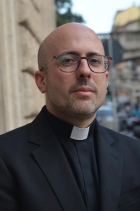
In a video broadcast during the presentation, Father Roberto Regoli, president of the Ratzinger Foundation, presented the Foundation's many activities, highlighting how the important milestone of the centenary of the birth of Joseph Ratzinger-Benedict XVI will be celebrated worldwide through numerous initiatives coordinated by the Vatican Foundation. And the Foundation's secretary, Professor Pierluca Azzaro, explained that "today officially begins the centenary of Benedict XVI, which will end on December 31, 2027, the anniversary of his death." "I can testify," Azzaro stated, "after the translation of 10 volumes of Benedict XVI's Complete Works, that the idea of positive secularism, of healthy secularism, is truly at the center of his thought.
The speech by Monsignor Salvatore Fisichella, Pro-Prefect of the Dicastery for Evangelization, began with a question: "Why is Ratzinger's thought still so relevant?", then developed several considerations. The first is "Ratzinger's conception of faith." "Two verbs are fundamental to understanding his thought, starting from when Ratzinger wrote the Introduction to Christianity in 1968-69," Monsignor Fisichella began. In that text, "there are two verbs: faith is a state of being, a being present, and an understanding. These two expressions also allow us to understand why a text from 1969 is profoundly relevant today." First of all, "the Church's duty to remain faithful to its historical time, to the time in which it lives, to the time in which it is called to give a meaningful response to the men and women of its time." The other dimension is "understanding": "The Church must also understand," which "is not just the reading of events, the signs of the times," but "the relationship between faith and reason," which "are called to dialogue, to relate to one another," going back to Augustine: "In the relationship between faith and reason, that intus legere is created, that capacity for intelligence that allows for depth to knowledge itself." Reason must be broadened; that is, it needs not to close in on itself. "This entering into depth allows us to grasp that truth that endures forever. This is why these pages seem profoundly timely," the archbishop noted, "because the truth that has been received through intuition is a truth that endures, a truth that is not subject to historical change, but endures as a great discovery, as an acquisition made through the labor of knowledge, guided by a further depth which is precisely that of faith." Hence the conclusions: "The Church, if it wishes to be truly itself, must be the Church of Jesus Christ, nothing else." "The Church in its essence is the creature of Christ, the mediation of his revelation that endures throughout history." The Christian community must regain its credibility, and to this end—as Ratzinger recalled in his last conference as cardinal in Subiaco and as stated in the 1969 article included in the volume—"we need men who keep their gaze fixed on God to be able to illuminate today's history and illuminate with their thoughts and hearts the personal condition of every person in today's world. That is, we need holiness, saints. This is the conclusion Ratzinger reaches." "If the Church wishes once again to speak a meaningful word to today's world, if its presence is still to be credible, it needs to ensure that men and women still live the dimension of holiness. This is the nature of the Church, this is what the Church is called to be: a place where holiness is lived and witnessed through the example and lifestyle of men and women of faith." Finally, recalling a 2021 text included in the book, the dimension of prayer: "Prayer is discovering that we are in the presence of God, but it also means praying with Christ. And this "praying with" becomes the recovery of one of the central tenets of Ratzinger's theology, that of the Eucharist. This "praying with" is not just being in the presence of God, but having the company of Christ who introduces you to true prayer. Therefore, only to the extent that you 'pray with' Him does that prayer reach the altar of God and become acceptable to the Father.
Professor Davide Prosperi, president of the Fraternity of Communion and Liberation, after mentioning the friendship between Cardinal Ratzinger and Father Luigi Giussani, founder of the Movement, recalled, among other things, some similarities between the two. First, "the unity between the celebrated faith, worship, and ordinary life," one of the essential tenets of Father Giussani's charism, who affirmed that "the entire life of a Christian should be a lived Mass." Second, Ratzinger's prophecy of "a time when the Church will increasingly become a minority from a social and even cultural standpoint."
The meeting, moderated by Maria Antonietta Calabrò, journalist and writer, was attended, among others, by Cardinal Giovanni Battista Re, Dean of the College of Cardinals, Archbishops Fortunatus and Nwachukwu and Guido Pozzo, Bishop Edoardo Aldo Cerrato, several ambassadors and members of the Diplomatic Corps accredited to the Holy See.
This is the link to watch the video of the presentation on the YouTube channel of the Italian Embassy to the Holy See:https://www.youtube.com/watch?v=0tRXn5re6sE&t=1215s
Luca Caruso